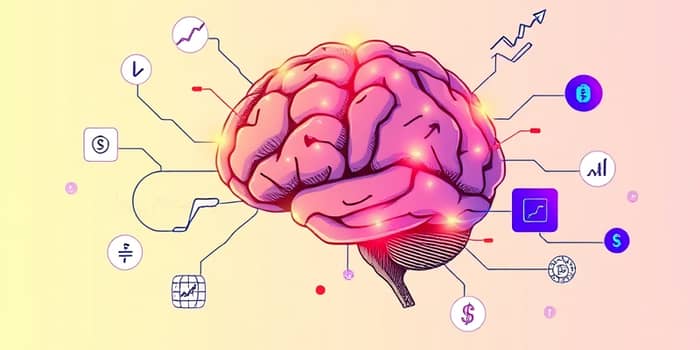
In the rapidly evolving world of finance, a new paradigm is emerging that promises to revolutionize how we manage money, assess risk, and make decisions.
Adaptive learning systems, powered by self-learning AI, are transforming financial intelligence from a static concept into a dynamic, ever-evolving force.
These systems seamlessly integrate financial data and decision processes to create a continuous feedback loop that enhances both institutional and individual financial acumen.
By learning from behavior and markets in real time, adaptive systems offer unparalleled personalization and efficiency.
They are reshaping everything from fraud detection and trading strategies to financial education and risk management.
This article delves into how these systems work, their key applications, and the profound impact they are having on the financial landscape.
Adaptive learning originated in education, where technology adjusts content based on learner behavior.
In finance, it evolves into adaptive financial intelligence, blending AI with data to optimize decisions.
This approach allows systems to learn, adapt, and self-correct in real time as environments change.
Key traits include continuous learning, feedback loops, and context awareness.
The architecture of adaptive systems involves a multi-step pipeline that ensures constant improvement.
It starts with data ingestion from various sources like transactions and market streams.
Feature extraction converts this data into meaningful insights such as spend velocity.
Learning algorithms, including supervised and reinforcement methods, drive the adaptation.
The decision layer produces scores or actions, like approving transactions instantly.
Feedback and adaptation monitor outcomes to update parameters continuously.
This contrast highlights how adaptive systems outperform static models by evolving with new data.
Adaptive AI revolutionizes risk management by offering dynamic and personalized assessments.
It learns from extensive client behavior, such as 24 months of data, to improve credit decisions.
For example, Equifax used adaptive deep learning to approve additional loans without increasing losses.
Systems adjust credit limits and pricing based on real-time signals like income changes.
This leads to individualized risk profiles that go beyond traditional scorecards.
Such capabilities make financial services more inclusive and efficient.
Fraud detection benefits immensely from adaptive systems that learn from each transaction.
These systems update detection rules on the fly, catching nuanced anomalies in milliseconds.
They learn normal behavior for each user, flagging unusual patterns beyond static thresholds.
This results in higher accuracy and reduced false positives compared to rule-based systems.
Real-time anomaly detection ensures that legitimate transactions are not inconvenienced.
Adaptive AI makes financial systems more resilient to evolving threats.
In wealth management, adaptive systems tailor portfolios to individual goals and risk tolerance.
Robo-advisors use AI to provide personalized financial advice based on changing circumstances.
They continuously re-evaluate portfolios using market conditions and client behavior.
Behavioral coaching delivers context-specific nudges, like warnings about over-concentration.
Over time, these systems learn client reactions and adapt intervention styles.
This empowers individuals to make smarter financial decisions.
Adaptive learning transforms trading by adjusting strategies to market conditions in real time.
Algorithmic trading systems use reinforcement learning to optimize policies based on P&L feedback.
They adapt to volatility regimes, liquidity conditions, and order-book patterns dynamically.
Portfolio management incorporates new data like news sentiment for tactical shifts.
NLP on social media provides inputs for asset allocation updates.
This leads to more responsive and profitable investment approaches.
Operational efficiency is boosted through adaptive AI in document processing and resource allocation.
For instance, JPMorgan Chase's COiN platform reviews thousands of agreements in seconds.
Adaptive components improve accuracy as new formats are encountered.
In customer service, intelligent chatbots learn from interactions to resolve issues better.
Systems optimize staffing and ticket routing in areas like collections and underwriting.
This streamlines financial institutions and enhances user satisfaction.
The future of adaptive learning in finance points towards fully autonomous systems.
As AI continues to advance, we can expect even greater integration and intelligence.
Trends include the rise of explainable AI for transparency and ethical considerations.
Systems will become more proactive, predicting needs before they arise.
This evolution will democratize access to sophisticated financial tools for everyone.
Embracing adaptive learning is key to thriving in the future financial landscape.
References