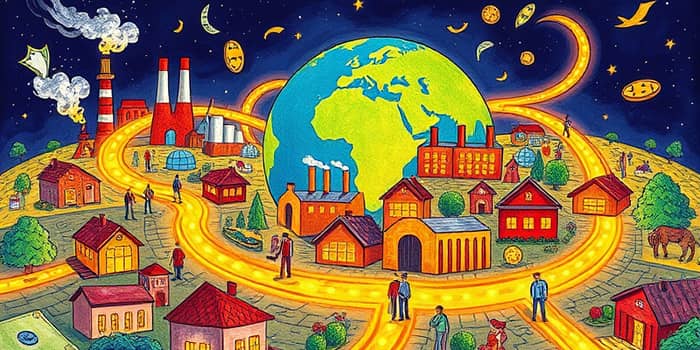
The movement of money, goods, and services through an economy forms the lifeblood of prosperity. By exploring the circular flow of income model, we uncover how each transaction generates value, influences growth, and shapes the distribution of wealth. This article journeys through history, theory, and policy to illuminate pathways toward a healthier, more dynamic economy.
The concept of economic circulation dates back to the 18th century. François Quesnay’s Tableau économique depicted agricultural surplus as the prime driver of wealth, funneled through rent, wages, and purchases. His work laid the groundwork for later visualizations.
In the early 20th century, Frank Knight likened economic exchange to “the wheel of wealth,” emphasizing the continuous exchange of productive power for consumer goods. Meanwhile, Karl Marx introduced the idea of simple and expanded reproduction, distinguishing between economies that merely sustain themselves and those that grow by reinvesting surplus value.
At its simplest, the circular flow model features two sectors: households and businesses. Households supply labor and demand goods, while firms produce goods and services, paying wages in return. Money flows clockwise from firms to households as income, and goods and services flow counterclockwise from firms to households.
Expanding to a five-sector model adds governments, financial institutions, and foreign trade. Here, injections and leakages shape the economy’s health. When total leakages—savings, taxes, and imports—exceed total injections—investment, government spending, and exports—a contraction ensues, potentially leading to recession.
Equilibrium in a modern economy hinges on balance. When money removed from the system equals money added, income, output, and expenditure remain stable. Financial intermediaries, such as banks and investment firms, play a pivotal role by channeling savings into productive investment.
This equilibrium underpins sustained growth. When injections exceed leakages, expansion occurs; the reverse leads to contraction. Policymakers monitor these flows to adjust fiscal and monetary tools accordingly.
Such conditions ensure that each layer of society participates in economic activity, preventing stagnation and fostering resilience against downturns.
In recent decades, capital owners have captured an increasing share of economic returns. Thomas Piketty’s research shows that when the rate of return to capital exceeds the growth rate of the economy, wealth concentrates among investors, leaving laborers behind. Technology, with near-zero marginal costs, accelerates this shift, transferring value from human effort to capital ownership.
As a result, middle-class savings have stagnated, household debt has risen, and a “permanent liquidity trap” emerges, where excess funds accumulate in corporate coffers instead of funding real activity. This imbalance undermines effective demand and threatens long-term stability.
Economist Richard Cooper argues that by dynamically redistributing wealth flows, societies can unlock higher productivity and greater aggregate prosperity. Fiscal policy should aim to channel sufficient funds from affluent segments back into the broader economy, fueling consumption and investment.
Emerging technologies—automation, artificial intelligence, and digital platforms—reshape how value is created and distributed. While these innovations promise efficiency gains, they also risk amplifying wealth concentration if left unchecked.
Models of universal basic income, profit-sharing schemes, and cooperative ownership structures offer potential remedies. By ensuring that productivity gains are shared broadly, economies can maintain robust consumption and sustain growth in the face of rapid technological change.
Real wealth lies not in hoards of cash, but in the continuous flow of resources through productive exchanges. A system focused on maximizing real long-run wealth recognizes that short-term accumulation at the top ultimately stifles the very growth it depends on.
Policymakers, business leaders, and citizens all have a role in fostering an economy where money, labor, and innovation move freely, creating opportunities for everyone. By understanding the pathways of capital currents and actively managing leakages and injections, we can build a more equitable, resilient, and prosperous future.
Now is the time to reimagine wealth flow as a shared endeavor—one where every transaction reinforces the circular motion of opportunity and progress.
References