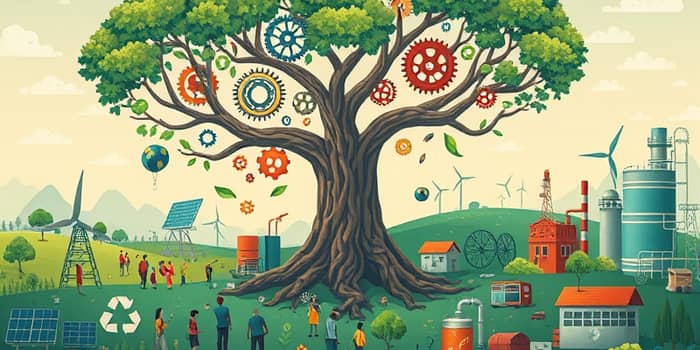
The transition to a circular economy represents an urgent shift from the traditional linear model of “take-make-waste” to one that restores and regenerates natural systems. Finance plays a pivotal role in this transformation, channeling capital into projects that deliver environmental, social, and financial returns.
Circular economy fundamentals rest on three intertwined principles that guide every stage of a product’s life-cycle. By embedding these practices across industries, we can begin to close loops, minimize pollution, and revitalize ecosystems.
These pillars extend product lifecycles through sharing, leasing, repairing, refurbishing, remanufacturing, and recycling. Each action reduces the extraction of raw materials, lowers greenhouse gas emissions, and secures materials for future generations.
Circular finance encompasses the range of financial instruments, investment strategies, and services explicitly dedicated to funding circular economy initiatives. It channels capital into resource-efficient projects, waste reduction technologies, and ecosystem restoration efforts, ensuring that every pound or dollar invested generates multiple returns.
Key definitions and frameworks have emerged to guide stakeholders:
By aligning financial incentives with circular objectives, investors and borrowers can pursue innovation without sacrificing resilience or profit.
The year 2026 marks an inflection point for circular economy investment. Strengthening policy frameworks, rapid technological advancement, and shifting consumer preferences are converging to unlock new opportunities and reshape capital markets.
Globally, the circular economy could generate an additional output by 2030 of $4.5 trillion, according to Accenture. Yet today, the world remains only 8.6 percent circular, revealing vast untapped potential.
Governments play a critical role. In the UK, the Circular Economy Growth Plan and related incentives signal long-term commitment. In the EU, regulations mandating reuse, leasing, and repair are harmonizing markets and reducing compliance complexity.
Corporate leaders are discovering that circular strategies decouples economic growth from finite resources. By securing raw material supply chains, businesses cut volatility, lower costs, and tap into new customer segments that value sustainability and resilience.
Despite momentum, significant barriers remain. Legacy infrastructure, contamination of recyclable streams, and reliance on export markets hamper progress.
Solutions are already emerging: advanced AI-driven sorting, chemical recycling pilots, harmonized public-private frameworks, and innovative financing models that blend concessional capital with market-rate returns. Together, these enablers can bridge the gap between pilot programs and full-scale deployment.
Investing in circular economy finance is not just an environmental imperative—it is a strategic opportunity to generate resilient returns amid resource constraints while restoring natural capital.
By directing capital towards regenerative projects—such as ecosystem restoration bonds, circular infrastructure funds, and blended finance vehicles—we can cultivate systems that endure and adapt in the face of uncertainty.
The journey to a circular future demands cooperation among governments, financial institutions, businesses, and civil society. Each stakeholder has a role to play in unlocking innovation, scaling solutions, and embedding regenerative design into the fabric of our economies.
As investors, entrepreneurs, and policymakers align on shared goals, the vision of a thriving planet where resources circulate endlessly becomes ever more attainable. The time to act is now: by investing in circular economy finance, we sow the seeds of a resilient, restorative future for generations to come.
References