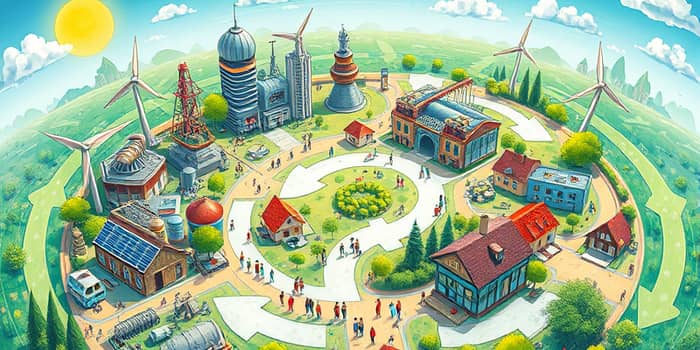
In an era defined by resource constraints and environmental urgency, the circular economy offers an inspiring vision of sustainable growth. By rethinking product lifecycles, investors can drive both meaningful ecological benefits and attractive financial returns.
As corporations and governments adopt new frameworks, the stage is set for transformative change that aligns profitability with planetary health.
The circular economy shifts away from the linear “take-make-waste” model to prioritize minimizing waste and preserving resources throughout every stage of a product’s life. Core principles include circular design, extended product use through reuse and repair, high-efficiency recycling, and value recovery through upcycling.
Enablers such as digital platforms, advanced recycling technologies, and supportive policy frameworks amplify these efforts. At its heart, the circular economy fosters a regenerative system where materials and products continuously flow back into production, reducing environmental impact and resource scarcity.
Global investments in circular economy ventures have skyrocketed, rising from $10 billion in 2018 to $28 billion in 2023, and peaking at $42 billion in 2021. This represents an 87% surge in capital over recent years versus the preceding period. Yet, these figures account for just 2% of all tracked sustainable investments—highlighting immense room for expansion.
Industry experts estimate that circular strategies could unlock $4.5 trillion in economic value by 2030, driven by resource efficiency, reduced waste management costs, and new business models that generate recurring revenue streams.
Investors are channeling funds into a range of high-potential areas, each contributing critical pieces to the circular puzzle. From advanced sorting facilities to digital marketplaces, innovation is transforming how materials and products circulate.
Several powerful forces are propelling capital into circular ventures. Companies seek greater resilience against commodity price volatility and supply disruptions, while regulators worldwide advance mandates for recycled content and extended producer responsibility.
Meanwhile, consumers demand sustainable products and robust environmental accountability. This confluence of factors is rapidly reshaping investment strategies.
Despite robust momentum, the market faces hurdles that require strategic attention. Inconsistent definitions and standards impede cross-border investment, while policy uncertainty in many regions slows large-scale deployment of circular infrastructure.
Most capital currently gravitates toward established recycling and repair models, leaving upstream design and production innovations massively underfunded. Addressing these gaps will unlock transformative impact.
To overcome these barriers, stakeholders should focus on high-impact, underfunded circular innovations, supporting upstream research in materials science and business model experimentation.
Closed Loop Partners has demonstrated the power of targeted capital, keeping 16 billion pounds of material in use and avoiding 25 million metric tons of CO₂ emissions through more than 90 investments. Their portfolio exceeds $5 billion in active materials circulation.
The International Finance Corporation (IFC) has invested over $1.9 billion in circular projects since 2015, mobilizing nearly $500 million in additional financing. Noteworthy programs include e-waste recycling in Brazil, textile reuse in Türkiye, and scrap steel processing in Ghana.
These examples showcase how strategic investment not only delivers measurable environmental impact but also yields robust returns, particularly in emerging markets where resource efficiency alleviates raw material import costs and creates local jobs.
To capture the full potential of circular economy opportunities, capital allocators and regulators must adopt forward-looking approaches. Investors should update risk and valuation models to reflect asset longevity, reduced resource exposure, and recurring revenue from product-as-a-service frameworks.
Blended finance structures and catalytic loans can de-risk early-stage circular innovations, particularly those focused on novel materials design. Policymakers, in turn, can harmonize definitions through guidelines, expand EPR schemes, and incentivize circular procurement in the public sector.
Collaborative initiatives between public agencies, multilateral development banks, and private financiers can amplify impact and ensure that capital flows to sectors with the highest environmental and social returns.
The global economy remains only 6.9% circular, underscoring a vast opportunity for growth and impact. By channeling capital toward resource-efficient business models, stakeholders can generate strong financial returns while fostering environmental resilience.
Now is the time for visionary investors, corporations, and governments to unite around this powerful economic paradigm. Through strategic finance, innovative policy, and unwavering commitment, we can accelerate the transition to a truly circular future.
Embracing circular economy investments means reduced raw material imports, robust supply chains, and a healthier planet for generations to come.
References