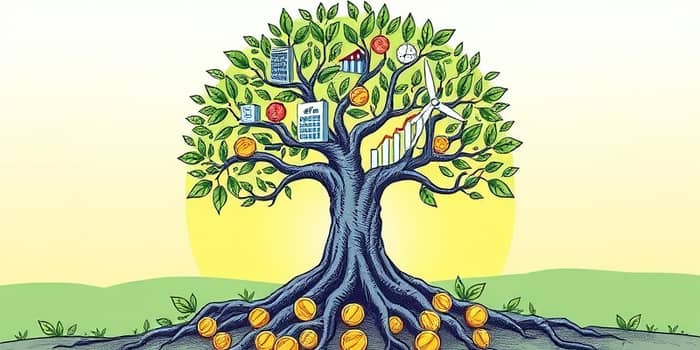
In today's fast-paced financial landscape, the quest for growth often prioritizes speed over sustainability, leaving many investors and businesses vulnerable to market shocks.
True prosperity, however, stems from cultivating continuity—a deliberate strategy that builds enduring financial growth by weaving together macro insights, firm-level discipline, and resilient portfolio approaches.
This article will guide you through practical steps to embrace this mindset, helping you navigate uncertainty and secure long-term success with holistic and forward-thinking frameworks.
By focusing on structural trends rather than fleeting opportunities, you can transform volatility into a catalyst for steady advancement.
Let's embark on this journey to build a financial future that not only grows but endures.
Understanding the broader economic environment is crucial for laying a foundation of enduring growth.
Key trends from 2024 to 2026 highlight why continuity should be your central focus.
Interest rates are expected to fall across major markets, which typically lowers the cost of capital.
This creates a window for financing expansion but demands discipline to avoid overleveraging.
Sustainability and ESG have evolved into long-term resilience levers, not just reputational add-ons.
Investors increasingly rely on ESG data in due diligence, recognizing the costs of misjudging risks.
Geopolitical shifts, such as European sovereignty themes, emphasize infrastructure and digital resilience.
These factors connect enduring growth to critical value chains and regional strategies.
To thrive, align your efforts with these structural currents rather than short-term fluctuations.
By integrating these insights, you can position yourself for sustained success in a changing world.
Capital is increasingly flowing toward sustainability-aligned assets, reinforcing the theme of continuity.
Despite some volatility, large pools of capital are building long-term positions in these areas.
For example, sustainable fund assets climbed to US$3.7 trillion, a 4% increase driven by market appreciation.
European investors remain firmly committed, with climate as their top priority and plans to increase impact allocations.
In Asia-Pacific, sustainable debt issuance is heading for a record year in 2025.
Green bonds, which finance projects like renewable energy, have grown from €30 billion to €1.9 trillion in a decade.
They offer similar risk profiles to conventional bonds but with added transparency and impact reporting.
The broader Green, Social, and Sustainability bond market now rivals the euro investment-grade credit sector.
Climate-related investment strategies, such as decarbonisation and nature solutions, are gaining traction.
These trends show that enduring growth aligns with systemic capital allocation for climate and biodiversity risks.
Embracing these flows can enhance your portfolio's resilience and long-term returns.
At the firm level, building enduring growth requires strategic capital allocation and operational resilience.
Start by strengthening your balance sheet to withstand rate cycles and economic downturns.
Invest in areas that support continuity, such as technology-driven ecosystems and sustainable practices.
For instance, focus on energy systems or digital infrastructure that align with macro trends.
Adopt frameworks like the Net Zero Investment Framework to reduce carbon exposure.
This not only mitigates risks but also accesses new opportunities in the transition economy.
Prioritize credible transition activities with regulatory clarity to attract capital.
Manage exposure to assets that may face de-financing, such as certain fossil fuel projects.
Early data shows banks reduced fossil fuel financing by about 25% in 2025, highlighting shifting priorities.
By aligning with long-term economic trends, you can avoid stranded assets and foster innovation.
These strategies ensure your firm not only grows but compounds value over time.
For investors, cultivating continuity means building portfolios that withstand political and market cycles.
Diversify across regions to balance risks, as seen in the divergence between US and European sustainability commitments.
In the US, there is pushback against ESG, but smart money continues to support renewables due to economic competitiveness.
Focus on assets with long-term structural economics rather than temporary narratives.
Incorporate green bonds and climate solutions equities to support the climate transition.
These instruments provide stability and align with growing regulatory frameworks like SFDR.
Monitor capital reallocation trends, such as the shift away from oil financing toward LNG and renewables.
Global sustainable development initiatives, like the Baku-to-Belém roadmap, aim to mobilize finance for climate goals.
By participating in these efforts, you can contribute to systemic change while securing returns.
Use the table below to compare regional approaches to sustainable finance, helping inform your allocation decisions.
This comparative view highlights opportunities for building resilient, cross-border portfolios.
These approaches empower you to navigate uncertainties and foster enduring wealth.
Implementing continuity requires actionable steps that integrate the insights discussed.
Begin by conducting a thorough assessment of your current financial position and goals.
Identify areas where you can align with macro trends, such as investing in infrastructure or sustainable funds.
Develop a disciplined capital allocation plan that prioritizes long-term resilience over short-term gains.
Engage with ESG data and reporting to enhance transparency and risk management.
For businesses, innovate in value chains to capture opportunities in energy or digital sectors.
For investors, diversify into assets that support climate adaptation and community health.
Stay informed on regulatory changes, such as European rules streamlining ESG disclosures.
This proactive stance helps you adapt to evolving standards and access new capital pools.
Remember, cultivating continuity is not a one-time effort but an ongoing commitment to growth.
By embracing these practices, you can build a financial legacy that thrives across generations.
These steps provide a roadmap for turning continuity into a tangible reality.
As you move forward, let the principles of endurance guide your decisions, ensuring that every investment contributes to a stable and prosperous future.
References