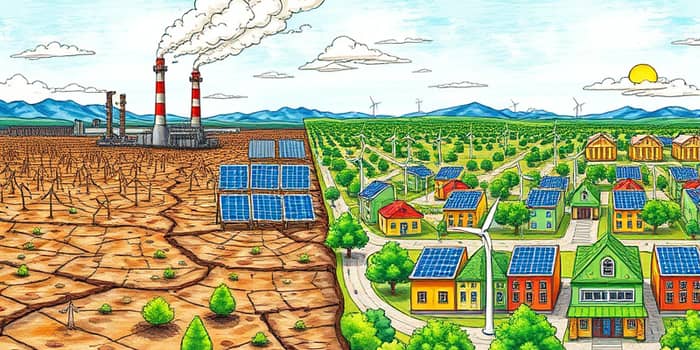
For decades, our economy has been trapped in a cycle of scarcity, where efficiency and cost-cutting prioritized short-term gains over long-term stability.
This mindset engineered fragility into our systems, leaving us vulnerable to disruptions like pandemics and climate change.
But today, we stand at a pivotal moment where a deliberate creation of surplus can transform this narrative, offering hope and practical solutions for a more resilient future.
The shift from scarcity to surplus is not just an economic theory; it is a necessary evolution to address inflation, inequality, and environmental challenges.
By embracing this transformation, we can build a world where abundance replaces lack, and uncertainty is managed for the common good.
Since the 1980s, globalization and a drive for efficiency reshaped our economy, but not always for the better.
Industries reduced domestic capacity, relying heavily on just-in-time delivery and lean supply chains.
This outsourced uncertainty to individual firms, creating a fragile network that could collapse with any disruption.
The pursuit of cost-cutting led to significant vulnerabilities.
Pre-pandemic, rising prices in housing, health care, and education signaled deeper institutional shortages.
These choices set the stage for the crises to come, highlighting how scarcity was a manufactured outcome, not an inevitability.
The COVID-19 pandemic exposed the cracks in our scarcity-driven economy in stark ways.
Shortages in tests, drugs, and hospital beds revealed how lean systems fail under pressure.
A shift to goods consumption stressed supply chains, spiking inflation in food, energy, and used cars.
Government interventions, like the CARES Act, provided temporary relief but underscored the need for systemic change.
This crisis was a wake-up call, demonstrating that our current model cannot withstand sudden shocks.
It pushed us to rethink how we allocate resources and manage risk.
To move from scarcity to surplus, government-led supply-side interventions are essential.
These strategies focus on boosting productive capacity and reallocating uncertainty to the public sector.
Key areas include energy, housing, and employment, where targeted actions can create lasting abundance.
Institutions like public banks, such as the Export-Import Bank, play a crucial role in funding green projects and global markets.
This approach embraces unbalanced growth, planning high-investment economies on the fly.
By shifting uncertainty from firms to the public sector, we can buffer volatility and ensure stability.
Incentives like subsidies and tax rebates spur innovation, as seen with DOE loans to Tesla for renewables.
This structured approach ensures that surplus is not just a concept but a tangible reality.
Understanding the economics of surplus is key to this transformation.
The surplus product refers to extra output beyond survival needs, driving progress since the agricultural revolution.
Modern surplus, as commodities or money, enables profit but risks unsold goods if demand lags.
The Corn Model emphasizes the quantity and quality of surplus from past investments.
Prices follow reproduction costs, with real adjustments through inventory and capacity.
This dialectic between scarcity and surplus shows how high productivity can create excess capacity.
When buying power is unequal, this leads to dumping and wealth concentration.
Market dynamics, like supply shifts, affect prices and consumer behavior through substitution and budgeting.
By mastering these concepts, we can design policies that harness surplus for public good.
Climate change adds urgency to the shift from scarcity to surplus.
Government steering is essential to provide sustainable goods that the private sector underproduces.
This addresses both short-term inflation and long-term environmental transitions.
Private banks often lag in cutting fossil fuel funding, highlighting the need for public intervention.
Surplus enables optimal allocation of abundance, reducing financial risks in green transitions.
It boosts flexibility, allowing economies to adapt to climate challenges without sacrificing growth.
Broader impacts include enhanced sustainability and resilience, making our systems more robust.
By integrating climate goals into surplus strategies, we can create a future that is both prosperous and sustainable.
The journey from scarcity to surplus offers a path out of our current economic dilemmas.
By learning from history and embracing innovative policies, we can build capacity that withstands shocks.
This transformation requires courage and collective action, but the rewards are immense.
The time for change is now, as we face interconnected crises that demand bold solutions.
Let us move forward with a vision of abundance, where surplus empowers everyone to thrive.
Together, we can turn the page on scarcity and write a new chapter of financial transformation.
References