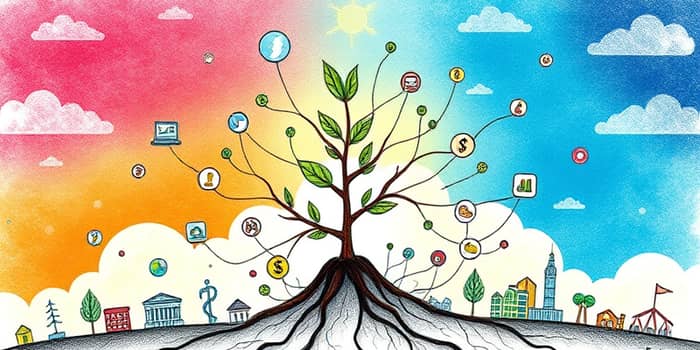
In an era defined by rapid technological breakthroughs and shifting economic landscapes, the traditional contours of finance are evolving into intricate, interwoven networks. These evolving collaboration models among institutions have given birth to what we now call financial ecosystems—dynamic architectures that blend public and private actors to deliver seamless, unified services. This article explores how these ecosystems emerge, the forces shaping them, and practical strategies for stakeholders to thrive on this journey from seed to scale.
Before embarking on our exploration, it is essential to understand the core concept. A financial ecosystem comprises banks, fintech companies, BigTech firms, regulators, enterprises, and customers collaborating to facilitate capital flows. Unlike siloed institutions, these ecosystems focus on persistent financial functions rather than institutions. They achieve funding allocation, maturity transformation, risk pooling, intermediation, and price discovery through complementary offerings.
At its heart, the ecosystem thrives on mutuality and shared value. Participants co-create value by leveraging each other’s strengths—banks provide trust and scale, fintechs inject agility and innovation, while regulators ensure stability and consumer protection. The result is a unified and seamless customer experience that transcends traditional boundaries.
Financial ecosystems exhibit three behavioral characteristics that set them apart:
Participants fall into four categories: capital providers, capital users, hybrid actors (like sovereign wealth funds), and meta-actors (central banks and market infrastructures). Each contributes unique capabilities, making the whole greater than the sum of its parts.
Five foundational drivers propel financial ecosystems forward. Understanding these forces empowers stakeholders to anticipate shifts and position themselves strategically:
The global fintech market has surged from $340.10 billion in 2024 to a projected $1,126.64 billion by 2032, at a compound annual growth rate of 16.2%. Payments remain the engine, with revenue reaching $2.4 trillion in 2023 and set to hit $3.1 trillion by 2028. Meanwhile, AI in fintech is forecast to exceed $83 billion by 2030, underscoring technology’s critical role.
Despite robust growth, funding patterns have shifted: fintech investments dipped to $95.6 billion across 4,639 deals in 2024, reflecting investor selectivity and focus on profitability. Yet 69% of publicly listed fintechs became profitable in 2024, up from less than half the year before—an indicator of business model maturation.
As the ecosystem expands, traditional banks face eroding market share. Neobanks, private credit providers, and trading platforms attract customers with transparency and specialization. This compels a shift from competition to co-opetition and strategic alliances. Banks must embrace partnerships with fintechs and technology firms to retain relevance.
Regulatory arbitrage and shifting compliance demands can strain resources. Institutions gain an edge by investing in regtech solutions that automate reporting and risk management. Meanwhile, cross-border collaborations can mitigate regional disruptions and unlock new markets.
By 2025 and beyond, resilience, agility, and data-driven intelligence will be the cornerstones of sustainable success. Ecosystem architects must:
Ultimately, the healthiest ecosystems balance diversification with prudent risk pooling. Crises will always test these networks, but institutions that nurture adaptive capacity and structural resilience will emerge stronger, driving inclusive economic growth and shared prosperity.
The journey from seed to scale is both challenging and exhilarating. It demands visionary leadership, a commitment to collaboration, and an unwavering focus on customer-centricity. Stakeholders who embrace the ecosystem mindset position themselves at the forefront of innovation, unlocking new revenue streams and expanding financial access globally.
By weaving together technology, regulation, behavior, geopolitics, and information networks, we can cultivate financial ecosystems that are robust, inclusive, and transformative. The future of finance will not belong to isolated institutions, but to interconnected networks that thrive on shared value across diverse participants. The seed has been planted—now is the time to nurture it into a forest of opportunity and progress.
References