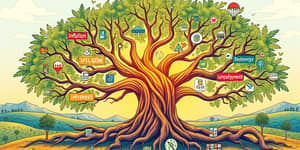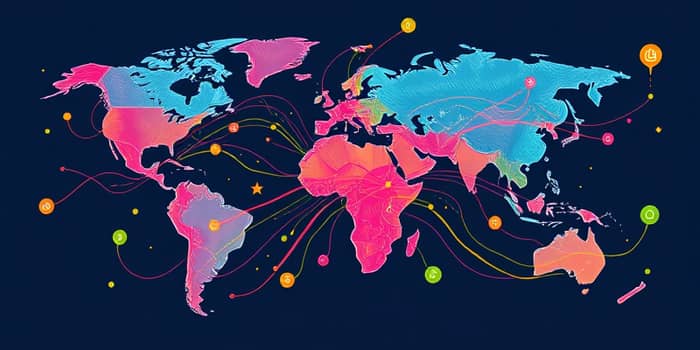
In 2025, the notion of market flow has become a compass for businesses and investors navigating an ever-evolving global economy. As money, demand, and information shift between regions and sectors, those who understand these movements gain a decisive edge.
This article explores unprecedented shifts in global growth patterns and reveals how to read the currents of capital, consumer demand, and information in a complex multipolar world.
At its core, market flow describes the movement of economic forces across regions, sectors, and consumer segments. It encompasses historic transfer of relative wealth and power from established markets to emerging economies. It also captures how capital deploys into frontier industries like artificial intelligence and sustainable technologies.
Beyond macro dynamics, market flow tracks shifts in consumer sentiment, spending habits, and marketing attention. By understanding these layered currents, decision makers can align strategy with momentum, rather than fighting against powerful tides.
Global growth projections from the World Bank’s latest Global Economic Prospects suggest a moderation to about 5.8% in 2025, with an average near 6.2% across 2026–2027, still below pre-pandemic norms. These figures reflect persistent debt burdens, tight financial conditions, and heightened geopolitical tensions.
The National Intelligence Council’s “Global Trends 2025” report outlines the emergence of a global multipolar order where China, India, and other rising powers reshape global governance. Nonstate actors—from multinational corporations to informal networks—wield increasing influence. Demographic shifts amplify these changes: Asia, Africa, and Latin America will drive almost all population growth through the mid-2030s, while Europe and Japan grapple with aging workforces.
The combined GDP of Brazil, Russia, India, and China is on a trajectory to match the original G7 share by mid-century, signaling a profound redistribution of economic weight. This historic transfer of relative wealth and power frames every other flow, from capital allocation to consumer trends.
Consumer behavior today reveals a curious decoupling: persistent uncertainty shaping consumer behavior coexists with surprisingly robust demand. McKinsey’s State of the Consumer 2025 finds that while sentiment remains below early 2020 levels, spending patterns have held firm.
Convenience is king. Shoppers expect fast delivery, seamless returns, and transparent pricing at all times. At the same time, localism gains traction: nearly half of consumers now say that supporting home-grown brands influences their decisions. In the US and Canada, preference for domestic businesses surged in early 2025, driven by a mix of patriotism and trust concerns.
Gen Z, now entering its peak spending years, adds another layer. This digital-first cohort is projected to double its spending growth rate compared to prior generations, potentially injecting $8.9 trillion into the global economy by 2035. Brands that speak Gen Z’s language—social values, agility, authenticity—will capture this localism and Gen Z’s emerging scale.
Capital flows are equally dynamic. Venture and private markets highlight three core sectors: AI, cybersecurity, and fintech. In 2024, about half of all AI VC deals moved beyond North America, reflecting growing geographic diversification of innovation and capital.
According to Stanford HAI’s AI Index 2025, private AI investment reached $109.1 billion in the US, dwarfing China’s $9.3 billion and the UK’s $4.5 billion. Generative AI attracted $33.9 billion globally, an 18.7% increase year-on-year. As policy frameworks tighten, government commitments have surged: China’s $47.5 billion semiconductor fund and Saudi Arabia’s $100 billion Project Transcendence exemplify massive government AI and tech investments.
Impact investing adds another dimension. Assets allocated to sustainable solutions have soared, as investors chase both financial returns and measurable social impact. The Global Impact Investing Network reports that capital targeting environmental, social, and governance goals now permeates every major market.
For businesses and investors, understanding market flow means marrying data with agility. Here are key approaches:
Marketers must also follow attention flows. Budgets are shifting from traditional media to digital platforms powered by AI-driven personalization. Brands that harness convenience and digital delivery expectations through seamless omnichannel experiences will outpace competitors.
The currents of 2025 are complex but navigable. From macroeconomic rebalancing to the digital adoption surge, these flows shape tomorrow’s winners and laggards. By monitoring capital allocations, consumer sentiment, and information channels, leaders can quality gap is shrinking to near parity synthesize insights and adjust course proactively.
Market flow is not a static map but a living system of interacting pressures. Embracing this dynamic lens empowers organizations to harness opportunity, mitigate risk, and chart sustainable growth paths in an ever-evolving global economy.
References