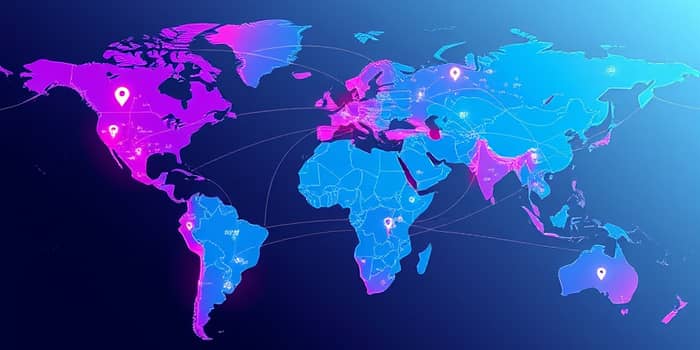
In an era defined by digital transformation, cross-border finance has become the lifeblood of globalization, driving growth for businesses large and small while uplifting local communities.
The global cross-border payments ecosystem is evolving at breakneck speed, offering both opportunity and complexity for institutions, regulators, and end users alike.
The total volume of cross-border transactions reached an unprecedented global transaction volumes of $194 trillion in 2024, scaling toward an estimated $250 trillion by 2027 and $320 trillion by 2032.
Beyond sheer scale, the market for associated services—fees, commissions, and technology solutions—is set to climb from $371.6 billion in 2025 to $620.15 billion by 2032 (CAGR 7.6%).
Bank transfers remain the backbone of B2B flows, while B2C cross-border volumes surge at a 9.6% CAGR, fueled by e-commerce, travel, and the gig economy.
Asia Pacific leads the charge, powered by China ($42.9B) and India ($25.37B) in 2025, where rapid digitization and innovation in real-time payment rails are transforming commerce.
North America’s $91.56 billion forecast is driven by U.S. modernization initiatives and deep fintech integration. Europe benefits from the European Central Bank’s push for interoperability and ISO 20022 adoption, enhancing data quality and compliance efficiency.
Latin America and MEA markets, though smaller in absolute size, exhibit the highest growth rates driven by remittances, digital wallet adoption, and new South–South trade corridors.
Despite progress, the industry grapples with compliance complexity, fraud risks, and high costs in underserved corridors.
Cross-border payments drive social and economic empowerment by connecting migrants, freelancers, and SMEs to global markets and remittance channels.
Remittances of nearly $905 billion in 2024 supported 771 million people, underpinning livelihoods and local development projects, from schools to small clinics.
SMEs, benefiting from digital platforms and lower transaction barriers, are expanding export opportunities and fostering inclusive growth in emerging regions.
By prioritizing agility, collaboration, and customer-centric innovation, financial institutions can unlock new revenue streams while building trust and reducing systemic risks.
As cross-border finance marches toward trillion-dollar scales, stakeholders must champion four imperatives:
Embracing these priorities will not only drive profitability but also cement finance’s role as a catalyst for global prosperity and local impact. The journey ahead calls for bold leadership, cross-sector collaboration, and unwavering commitment to innovation.
In this interconnected world, every transaction is more than a payment—it is a bridge linking communities, fueling entrepreneurship, and shaping the future of global commerce.
References