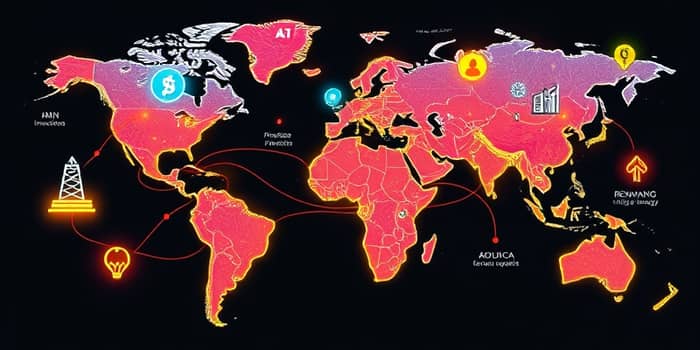
In an era of uncertainty and shifting economic tides, cross-border investment remains both a challenge and an opportunity for global capital. This article explores actionable strategies, data-driven insights, and emerging trends to help investors navigate this complex landscape.
Global foreign direct investment (FDI) flows experienced a modest decline in 2025, marking the second consecutive year of contraction. Driven by trade tensions, high interest rates, and geopolitical uncertainty, total FDI fell by 3% in the first half of 2025 and dropped 11% overall in 2024 to $1.5 trillion.
Yet this downward trajectory masks a deeper resilience: inward direct investment positions reached record $41 trillion FDI positions in 2023, up 4.4% year-on-year. Meanwhile, digital payment networks facilitated a surge in capital movement, fueling the rise of cross-border payment platforms and redefining how money travels globally.
Indeed, cross-border payment flows reached $194.6 trillion in 2024, with projections estimating growth to $320 trillion by 2032. These figures underscore the immense scale of financial interconnectivity, despite traditional FDI headwinds.
Developed economies witnessed an 18% fall in M&A activity in H1 2025, driven by caution among corporate acquirers. In contrast, developing regions showed mixed fortunes: Latin America & the Caribbean saw a 12% rise in FDI inflows, developing Asia rose 7%, while Africa declined sharply by 42%.
The United States remains the top FDI destination, with a stock of $5.7 trillion at end-2024—a 30% increase since 2019—and net equity flows of $39 billion in Q2 2025. European investors maintained their reciprocal relationship with the U.S., reallocating more than €125 billion into non-US equity funds.
Innovation sectors, particularly artificial intelligence and digital infrastructure, have become magnets for greenfield investment even amid broader pullbacks. More than half of new U.S. greenfield projects in early 2025 were AI-related, including $103 billion in semiconductor initiatives and $27 billion in data center expansions.
Meanwhile, manufacturing investments declined 29% in project counts, reflecting supply-chain de-risking and tariff uncertainties. Infrastructure and sustainable energy sectors also saw lower activity—greenfield project finance value fell 31%, and renewable energy deals dropped 10% in value during H1 2025.
Investors face significant headwinds: persistent trade disputes, geopolitical conflicts, and elevated borrowing costs. Yet easing financial conditions, a rebound in M&A, and renewed sovereign wealth fund activity could ignite a recovery later in 2025.
To capitalize on upside potential, market participants must assess and mitigate geopolitical risks effectively. Strategies include diversifying supply chains while maintaining access to key markets and leveraging public-private partnerships for large infrastructure endeavors.
Successful investors combine rigorous risk management with agility in capital deployment. Four pillars anchor a robust strategy:
Persistent volatility and economic fragmentation will likely characterize the near-term environment. However, targeted investments in technology, healthcare, and sustainable infrastructure—supported by innovative financing models—can unlock value for those who navigate the evolving terrain with foresight.
As global capital flows adapt to a multipolar world, investors who refine their risk frameworks, embrace digital platforms, and harness emerging sectoral growth stand poised to reap the benefits of a dynamic, interconnected market.
References