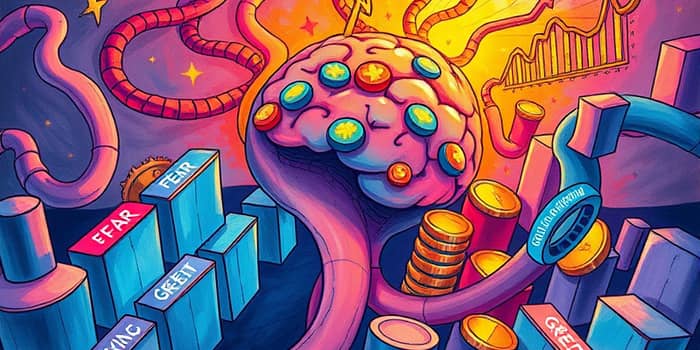
Finance has long been portrayed as a realm of cold calculations and rational choices.
Yet, beneath the spreadsheets, human emotions wield immense power, steering markets and portfolios in unexpected ways.
This reality transforms investing from a purely analytical pursuit into a deeply personal journey.
Understanding the emotional undercurrents can unlock better financial outcomes and peace of mind.
At its core, investing is not just about numbers; it's about people.
Markets are driven by collective human behavior, where fear, greed, and biases often overshadow logic.
This disconnect between rational theory and emotional reality defines the modern investor.
By delving into the psychology of finance, we can navigate these waters with greater insight and control.
Traditional finance models assume investors are perfectly rational actors.
These models suggest that people always optimize risk and return based on all available information.
In contrast, behavioral finance reveals a messier truth.
Emotions and cognitive biases consistently deviate from logical models, creating market anomalies.
This shift in perspective helps explain why bubbles form and crashes occur.
It underscores that financial decisions are rarely made in a vacuum.
Embracing this complexity is the first step toward smarter investing.
Fear and greed are often called the engines of market behavior.
These primal emotions can push investors toward irrational actions with significant consequences.
Greed fuels the desire for quick profits, leading to speculative bubbles.
Investors chase hot assets, overvaluing securities during booms without regard for fundamentals.
Fear, on the other hand, triggers panic selling during downturns.
This emotion drives people to flee to perceived safety, often locking in losses.
Recognizing these drivers can help investors pause and reflect before acting.
Beyond emotions, cognitive biases systematically distort financial decisions.
These mental shortcuts often lead investors astray, costing them money and opportunity.
Overconfidence is particularly insidious, as it can make investors believe they can beat the market consistently.
A study found that overconfidence significantly impacts investment choices, highlighting its prevalence.
Loss aversion, noted by around 50% of investors as a top irrational factor, often triggers poor timing.
Anchoring on purchase prices can prevent necessary portfolio adjustments.
Mental accounting distorts how we value money, affecting long-term goals.
By identifying biases, investors can develop checklists to mitigate their effects.
General emotional states also influence financial judgment beyond specific biases.
Mood can affect decision-making quality, sometimes in surprising ways.
A study showed that mild depression improved earnings forecast accuracy by reducing optimism bias.
This suggests that emotional states shape the deliberation process in investing.
It's a reminder that investing decisions are not made in isolation from our overall well-being.
Individual emotions scale up to form market sentiment, influencing volatility and returns.
Tools like the Fear and Greed Index measure this collective attitude.
Extreme sentiment is a significant predictor of market fluctuations, as studies confirm.
When fear dominates, sell-offs and higher volatility often follow.
Greed, in turn, can lead to overvaluation and bubble conditions.
Staying informed about sentiment can foster a more balanced approach.
The financial impact of emotions is quantifiable, showing clear patterns of underperformance.
The behavior gap describes the difference between investment returns and what investors actually earn.
This gap arises from emotional timing, such as buying high and selling low.
Research indicates that investor underperformance is concentrated during market crises.
About 70% of underperformance occurs in just 10 key periods of panic.
Over 30 years, the average equity investor lagged the market by about 2.14 percentage points annually.
This persistent gap stems from chasing performance and poor timing decisions.
By acknowledging these pitfalls, investors can focus on discipline over emotion.
Recent insights from neuroscience explain why emotions are so potent in finance.
The reactive brain, evolved for survival, responds swiftly to threats and rewards.
In investing, this system is triggered by potential losses or gains, driving impulsive actions.
Understanding this biological basis can help investors create buffers against instinctive reactions.
Integrating neuroscience with financial planning offers a holistic path to better investing.
Finance is ultimately a human story, woven with emotions and biases.
By recognizing the emotional investor within, we can transform weaknesses into strengths.
Practical strategies, such as diversification and regular rebalancing, mitigate emotional risks.
Building financial resilience requires both knowledge and self-awareness.
As we navigate markets, let's remember that emotions are not enemies but guides.
They remind us that investing is about more than money; it's about our hopes, fears, and dreams.
With this perspective, we can craft portfolios that reflect not just numbers, but our true selves.
Embrace the journey, learn from missteps, and invest with heart and mind in harmony.
References