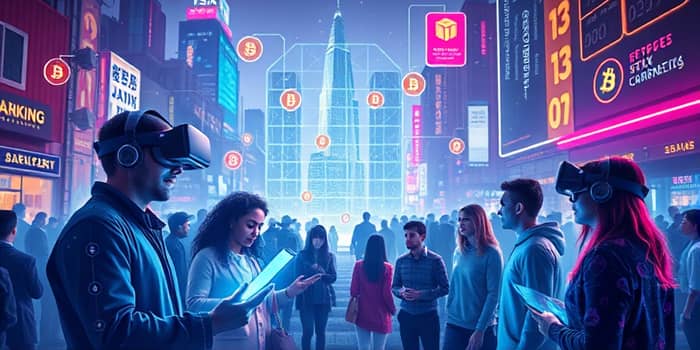
The intersection of finance and immersive technology is redefining the way we think about money, transactions, and customer experiences. Banking in virtual realities is no longer a distant concept—it is rapidly emerging as the next frontier in global commerce and innovation.
As institutions and individuals alike explore these new environments, understanding the opportunities, challenges, and practical steps for success has never been more critical.
In the coming decade, the metaverse is expected to transform financial landscapes at an astonishing pace. Analysts project global metaverse market revenue projected to reach $203.7 billion in 2025, with aggressive forecasts stretching to $1,273.58 billion by the same year. By 2032, estimates soar to $7,639.7 billion under a compound annual growth rate of 29.2%.
Within finance-specific segments, the metaverse could generate $876.2 billion in growth between 2025 and 2029 at an estimated 40.8% CAGR, up from a base of approximately $8.01 billion in 2022.
These figures underscore unparalleled opportunities for innovation in lending, DeFi, insurance, and digital asset management. Early adopters stand to capture significant market share, while consumers gain access to highly personalized, immersive services.
The metaverse is not merely a gaming fad—it represents a paradigm shift in customer interaction. Virtual branches allow users to open accounts, apply for loans, and consult advisors without ever leaving a digital realm. VR-powered analytics deliver real-time insights on spending patterns, enabling hyper-personalized offers and risk assessments.
Key financial metrics are already demonstrating robust adoption:
Meanwhile, fractional NFT vaults have achieved 73% year-over-year growth, driving a TVL of $2.6 billion. Tokenized real-world assets now exceed $33 billion, pointing to a future where everything from real estate to corporate debt can be seamlessly traded on blockchain networks.
Consumer and institutional uptake of metaverse finance continues to accelerate. By early 2025, active metaverse finance wallets numbered between 40 and 50 million, reflecting growing trust and experimentation.
Several indicators highlight user comfort and enthusiasm:
Financial institutions share this optimism: 87% of leaders expect at least 20% of consumers to use VR or AR transactions soon, and more than 30% plan to implement metaverse strategies by 2026. APAC regions alone anticipate over 15 million monthly active users by 2027.
The backbone of metaverse finance comprises advanced protocols, cross-chain bridges, and scalable Layer 2 rollups. Platforms like Decentraland, The Sandbox, and Somnium Space conduct billions in transactions annually, while Binance MiniVerse integrates spot trading and lending within immersive environments.
Notable technical breakthroughs include:
Regulated platforms now require KYC for 70% of users, enhancing security without sacrificing inclusivity. Virtual cards, when integrated, boost activation rates by 15% and transaction volumes by 23%.
Despite its promise, metaverse commerce faces significant hurdles. Security incidents, such as credential-stuffing attacks, rose 36% year-over-year, prompting projects to allocate $72 million in bug bounties across 50+ initiatives.
Regulatory frameworks lag behind technological advances. Institutions must navigate data privacy laws, anti-money laundering standards, and cross-border compliance. Without global guidelines, many organizations hesitate to fully embrace virtual banking.
Effective risk mitigation strategies include:
To unlock the potential of banking in virtual realities, institutions should:
By focusing on user-centric design and robust security, banks and fintechs can differentiate themselves, driving loyalty and long-term growth.
The convergence of finance and virtual reality represents a transformative shift in how we manage money, interact with institutions, and build communities. With market projections soaring into the trillions and adoption rates climbing rapidly, now is the moment for bold action.
Financial leaders who embrace immersive customer engagement experiences and harness the power of decentralized technologies will emerge as pioneers in a landscape defined by innovation, inclusivity, and resilience.
As the lines between the physical and digital worlds blur, banking in virtual realities offers not just a new channel—but a fundamental reimagining of commerce and human connection.
References