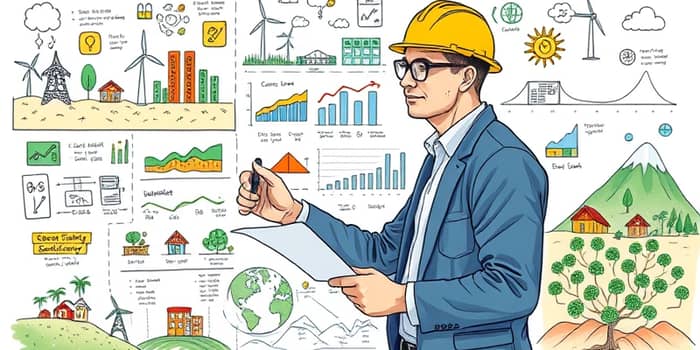
In an era defined by climate change, social unrest, and evolving stakeholder demands, finance professionals are stepping into a new role: that of the economic engineer. Beyond traditional profit-maximization, they are crafting frameworks that balance financial returns with planetary boundaries and societal well-being. This article explores how sustainable financial models integrate environmental, social, and governance principles into core decision-making, driving long-term value creation and resilience.
Historically, financial decisions prioritized short-term gains, often neglecting unseen costs like pollution, labor exploitation, or governance failures. Today, a growing consensus calls for frameworks that capture both financial metrics and external impacts.
By embracing holistic systems accounting externalities, economic engineers shift capital flows toward projects that deliver shared prosperity. This transition fosters stability, mitigates systemic risk, and aligns with rising regulatory and investor expectations.
At its heart, sustainable finance weaves ESG factors seamlessly into every stage of the investment lifecycle. Key components include:
These elements form the backbone of a model that redefines the role of capital—from mere financier to steward of sustainable development.
Economic engineers deploy a variety of tools to embed sustainability into financial structures. Below is a concise overview of three key mechanisms:
Each mechanism quantifies non-financial benefits, from carbon emission reductions to enhanced community well-being, integrating them into valuation models through quantitative assessment of environmental impacts.
Translating theory into practice requires deliberate adjustments across processes, policies, and culture. Financial institutions and corporate treasuries can adopt the following roadmap:
By making these changes, organizations ensure that sustainability is not an afterthought, but a core strategic imperative.
Leading corporations and public entities worldwide illustrate the transformative power of sustainable finance.
Amazon leveraged enhanced tax credits like the Investment Tax Credit (ITC) and Production Tax Credit (PTC) to scale its solar and wind portfolios, reducing costs while bolstering shareholder value. Meanwhile, Tesla generated over $2.1 billion in carbon credit revenue in 2023 by monetizing emissions allowances.
In healthcare, community health systems have blended Medicaid waivers, social impact bonds, and pay-for-success contracts to pursue the Triple Aim: improving patient outcomes, lowering costs, and enhancing experiences. These initiatives demonstrate how long-term viability and risk mitigation emerge from integrated models.
Emerging markets also provide fertile ground for sustainable finance. In Oman, India, and the UAE, inclusive green finance has unlocked capital for infrastructure, social services, and renewable projects, showcasing that embedded in core processes strategies can thrive across diverse socioeconomic contexts.
Despite its promise, sustainable finance faces hurdles: data complexity, standardization gaps, agency conflicts, and potential financialization of social goods. Economic engineers must navigate these obstacles through collaborative innovation.
Future advances will likely include improved system dynamics modeling to capture nonlinear feedback loops, refined behavioral finance insights to address investor biases, and evolving policy frameworks like mandatory ESG disclosures under TCFD standards.
Ultimately, the shift toward sustainable finance reflects a deeper transformation: viewing capital not merely as a tool for profit, but as a catalyst for positive change. As economic engineers, finance professionals are uniquely positioned to design resilient, equitable systems that serve both people and planet.
By embracing this expanded mandate, they will drive a legacy of prosperity that endures beyond single fiscal cycles, ensuring that future generations inherit a world where economic and ecological health prosper together.
References