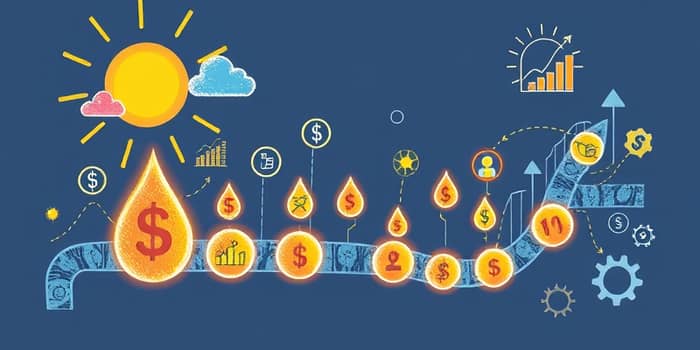
In today’s dynamic business environment, companies must master the art of accurate future revenue projections to stay ahead of the competition. A well-structured profit pipeline serves as both a roadmap and a catalyst, guiding organizations from initial lead generation to sustained growth. By integrating financial insights into every stage of the sales process, businesses can unlock hidden opportunities and forecast performance with unprecedented clarity.
This article delves into the core mechanics of the profit pipeline, showcasing how smart financial strategies transform potential into profit. Readers will discover practical methods to calculate pipeline revenue, optimize sales flow, allocate resources strategically, and leverage emerging revenue streams for long-term stability.
Understanding estimated future revenue from prospects begins with quantifying leads at each stage of the pipeline. Pipeline revenue represents the total value of all open opportunities, adjusted by their probability of closing. This aggregate figure becomes a powerful predictor of business health, informing budget decisions and staffing requirements.
To calculate pipeline revenue, follow this structured approach:
By multiplying the number of leads by their conversion rates and average deal value, organizations can derive a projected revenue line for each stage. Summing these figures yields total pipeline revenue, a critical benchmark for forecasting and strategic planning.
A healthy pipeline does more than predict income—it alerts stakeholders to potential bottlenecks before they become crises. Continuous flow requires reps, ensuring prospects transition smoothly from one phase to the next. Any stagnation in movement flags a need for immediate action, whether that means additional follow-up, specialized training, or refined messaging.
Early warning signals include sudden drops in pipeline volume, declining conversion rates, or extended sales cycles. Recognizing these patterns empowers leadership to reallocate resources, launch targeted campaigns, or refine product positioning, avoiding revenue shortfalls and preserving competitive advantage.
Designing an efficient pipeline involves defining clear stages and criteria for progression. Most organizations adopt a seven-stage model:
Tailor these stages to your unique market and customer behavior. Consistency in stage definitions maintains transparent visibility into deal health and avoids misalignment between marketing, sales, and finance teams.
Key management activities include:
With clarified pipeline metrics, firms can align budgets and staffing to forecasted revenue targets. Probability of deal closure at each stage refines budgeting, limiting overinvestment when prospects are weak and preventing missed opportunities when prospects are strong.
Pipeline coverage ratios—calculated by dividing total pipeline revenue by sales targets—indicate whether sufficient opportunities exist to meet quotas. A coverage ratio of 3:1, for instance, suggests three times more potential revenue than the quota, providing a buffer against underperformance. If coverage dips below this threshold, organizations should accelerate lead generation efforts or re-engage dormant opportunities.
Strategic resource allocation may involve hiring additional sales personnel, investing in marketing campaigns, or engaging subject matter experts to navigate complex negotiations. By analyzing resource effectiveness against pipeline movement, companies can optimize ROI and ensure that every dollar spent advances prospects toward closing.
Beyond the initial sale, profit pipelines support upsell and cross-sell strategies to maximize customer lifetime value. Once a deal closes, new opportunities emerge in the pipeline for upgrades or complementary products. By leveraging existing client relationships and trust, sales teams can generate incremental revenue with minimal acquisition cost.
Cross-functional collaboration between finance, sales, and customer success ensures that upselling initiatives align with budget forecasts and operational capacity. Data-driven insights, such as historical purchase patterns and churn risk analysis, further refine these initiatives, turning after-sales processes into new growth engines.
While the sales pipeline is a critical component, the broader revenue pipeline encompasses recurring subscriptions, renewals, referrals, and partnership income. Integrating these channels provides a holistic view of financial performance and identifies synergies across teams.
Companies that link subscription metrics—like monthly recurring revenue (MRR) and churn rate—to their sales funnel gain a unified perspective on customer acquisition and retention. Referral programs can be tracked as inbound leads, feeding directly into the early stages of the pipeline. Partnerships, meanwhile, often produce high-value deals that follow standard qualification and negotiation processes.
By consolidating all revenue streams within a single platform, leadership benefits from comprehensive financial transparency across functions and can make proactive adjustments to strategy. This integrated approach minimizes gaps in reporting and creates seamless coordination between growth initiatives.
Incorporating a profit pipeline transforms financial planning from guesswork into a scientific discipline. It empowers organizations with data-driven decision-making power, enabling proactive adjustments that safeguard against revenue fluctuations and capitalize on emerging opportunities.
By mastering pipeline construction and management—calculating future revenue, maintaining healthy deal flow, allocating resources strategically, and integrating multiple revenue channels—businesses secure a competitive advantage. The profit pipeline is not just a tool; it is the foundation of sustainable, scalable growth, driving profitability today and fortifying enterprises for the challenges of tomorrow.
References