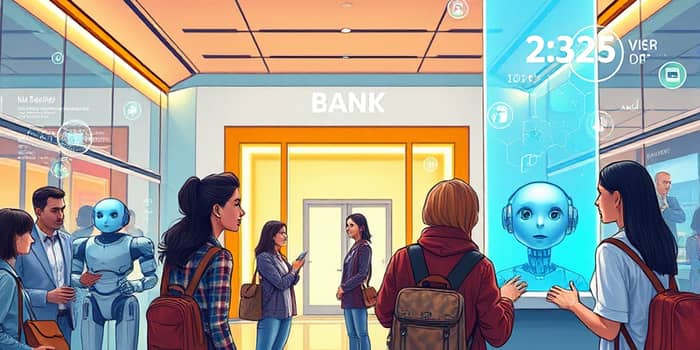
In a world where digital transformation shapes every facet of our daily lives, banking stands at the forefront of innovation. Voice interfaces are emerging as a powerful conduit between customers and financial institutions, offering unprecedented convenience and accessibility. From checking balances to executing transactions, spoken commands are redefining the way we interact with money. This transformation is not merely about technology; it is about empowering individuals to manage their finances with confidence and ease.
Imagine a scenario where you wake up, speak a simple request, and your bank responds instantly with tailored insights. This is no longer the realm of science fiction. Banks are integrating cutting-edge AI-driven conversational assistants into mobile apps, smart speakers, and in-branch kiosks. These systems harness natural language processing to understand intent and deliver real-time solutions.
Financial institutions are focusing on empathy and personalization, training voice bots to adopt friendly tones and recognize individual patterns. This approach fosters trust and reduces friction, making every interaction feel as natural as talking to a human advisor. The resulting experience is more intuitive, accessible, and inclusive, especially for customers with visual impairments or limited literacy.
The global voice banking sector is witnessing rapid global expansion of voice banking, with valuations skyrocketing from $1.38 billion in 2023 to a projected $2.99 billion by 2028. Alternative forecasts paint an even more ambitious picture, estimating growth to $3.73 billion by 2032 or surging to $20.49 billion by 2033. The convergence of IoT, AI research breakthroughs, and consumer appetite for seamless interactions are key factors driving this trajectory.
Regionally, North America leads adoption, commanding the largest market share, while Asia-Pacific emerges as the fastest-growing hub. China alone contributes over 55% of APAC revenue, fueled by tech-savvy consumers and proactive banking regulators. In Latin America, the concept of “invisible banking” is gaining traction, with 77% of financial leaders embracing AI to deliver frictionless services.
At the heart of each voice system lies an intricate web of algorithms. Machine learning models decode spoken words, while deep neural networks interpret context and sentiment. Voice synthesis engines transform digital responses into lifelike speech, completing the conversational loop. Behind the scenes, cloud-native architectures ensure scalability to handle millions of interactions simultaneously.
Security remains paramount. Banks leverage cutting-edge voice authentication systems to create unique voiceprints based on pitch, rhythm, and pronunciation. These biometric profiles provide secure and seamless banking experience, drastically reducing fraud and enhancing compliance. As multimodal AI models gain traction, by 2026 nearly 40% will blend voice with text and visual cues to offer richer, more nuanced dialogues.
Voice banking adoption is surging across devices and demographics. In the U.S. alone, nearly 153 million users are expected to engage with voice assistants by 2025. Smartphones lead the charge, with 56% of interactions, followed by smart speakers at 35%. Enterprises are equally bullish: 94% of organizations now run AI in production, and 82% employ voice-driven applications to streamline workflows.
Key benefits include:
Financial leaders report operational cost savings of up to 30% in contact center expenses. Beyond efficiency, voice interfaces humanize digital banking, building deeper emotional connections with customers and fostering loyalty.
From routine inquiries to complex transactions, voice interfaces are reshaping everyday banking tasks:
By integrating tailored multilingual support and personalization, banks can serve diverse customer bases, ensuring no one is left behind. This inclusivity drives adoption and enriches the overall customer experience.
Despite promising momentum, the voice interface landscape faces hurdles. AI-driven deepfakes and voice spoofing are evolving threats, demanding advanced anti-fraud measures. Ensuring consistent performance across dialects and background noise remains an engineering challenge. Moreover, regulatory frameworks must adapt to cover voice-based transactions and privacy safeguards.
Looking ahead, the voice banking ecosystem is poised for further innovation:
By 2034, voice AI infrastructure could be valued at $133.3 billion, underscoring the long-term potential of conversational banking.
The conversational revolution in banking is more than a technological trend; it is a cultural shift toward human-centric finance. Institutions that embrace voice interfaces can unlock unprecedented levels of engagement, efficiency, and trust. For customers, this means banking that listens, understands, and responds to individual needs, anytime and anywhere.
As the industry accelerates toward a future where voice becomes the primary user interface, stakeholders must collaborate to address security, standardization, and accessibility. By doing so, we will create a financial landscape that is not only smarter and faster but also more inclusive and empathetic.
Together, let us embark on this journey to redefine banking through the power of conversation, forging a path toward financial empowerment for all.
References